


May 30, 2026

What is GEO in SEO? (5 Ways to Rank in AI Search 2026)

Share this article

GEO (Generative Engine Optimization) is the process of optimizing content to be recognized, cited, and recommended by AI-powered search engines and generative models. Unlike traditional search, GEO focuses on making information highly interpretable for Large Language Models (LLMs) to ensure your brand appears in AI-synthesized answers.

What is GEO in SEO and why should you care?

The search landscape is undergoing its most significant transformation since the invention of the backlink. For decades, we have focused on ranking in a list of blue links. However, with the rise of Google’s Gemini, ChatGPT, and Perplexity, users are increasingly receiving direct, synthesized answers. This is where GEO in SEO comes into play. It is the evolution of visibility, shifting the focus from simply being "found" to being "cited" by AI.

At adPRO, we have watched the digital space evolve since 1999. We have seen the shift from keyword stuffing to mobile-first indexing, and now, we are entering the era of the generative engine. If your business relies on organic traffic, understanding how these AI engines consume and regurgitate data is no longer optional. GEO is about ensuring that when a user asks an AI a question about your industry, your business is the one the AI trusts to provide the answer.

Businesses that ignore this shift risk becoming invisible in a world where users no longer click through ten different websites to find a solution. By optimizing for generative engines, you are positioning your brand as an authority that AI models can rely on. This involves a blend of technical structure, high-quality sourcing, and a deep understanding of natural language processing.

AI search visualization

How does Generative Engine Optimization differ from traditional SEO?

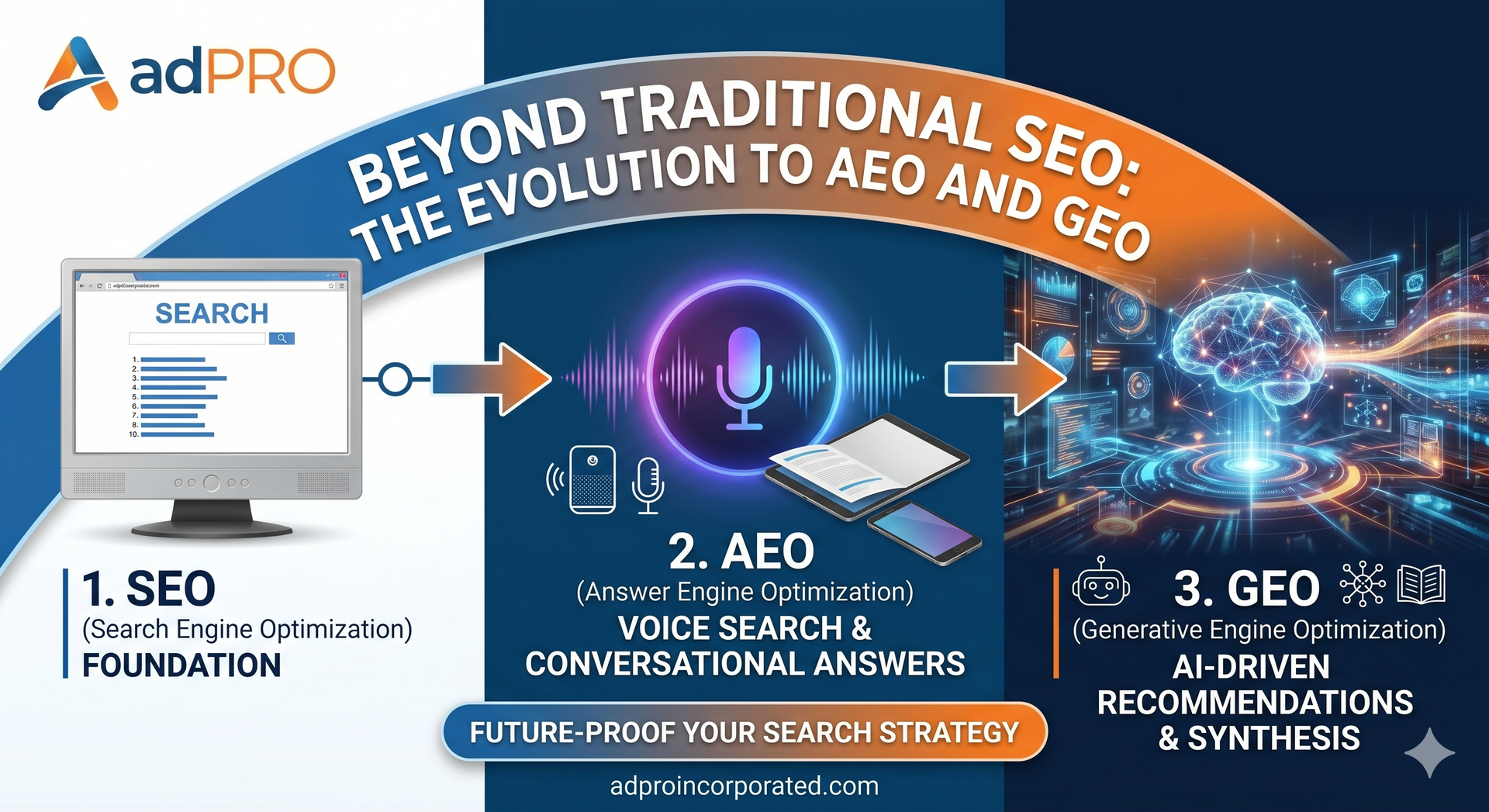
While traditional Search Engine Optimization is about keywords, backlinks, and site speed to please a crawler, GEO is about semantic meaning and authoritative proof to satisfy an LLM. Traditional SEO helps you rank #1 on a results page; GEO helps you become the "source" that the AI mentions by name in its response. The metrics of success are shifting from Click-Through Rate (CTR) to Citation Rate.

There are several key differences in how these two disciplines approach content:

  • Intent vs. Keywords : Traditional SEO targets specific phrases, while GEO targets the underlying intent and the conversational context of a query.
  • Structure vs. Narrative : AI engines prefer data that is structured for easy extraction but written in a natural, authoritative narrative.
  • Authority Signals : In GEO, being cited by other reputable sources matters more than just having a high volume of low-quality backlinks.
  • Directness : Generative engines favor content that gets straight to the point without unnecessary fluff.
  • Formatting : Lists, tables, and concise summaries are highly prioritized by AI models for extraction.

To bridge this gap, many businesses are turning to AEO and GEO Optimization services. This hybrid approach ensures that while you are still ranking in traditional search, you are also being prepared for the generative future. It is about playing both sides of the coin to ensure total market coverage. Traditional SEO provides the foundation, but GEO provides the future-proofing.

We often see clients who have great rankings but low conversion from AI-driven tools. This happens because their content is optimized for a bot to crawl, but not for an intelligence to understand. By refining your Website Design and content strategy to include clear, factual, and verifiable data, you make it easier for an AI to trust your brand's information over a competitor’s.

The Core Pillars of a Winning GEO Strategy

To win in the age of generative search, you need more than just a blog; you need a strategy built on data and authority. Since our founding, we have believed that great marketing starts with understanding the end goal. In the case of GEO, that goal is being the most reliable source of truth in your niche.

Here are the fundamental pillars you should focus on to improve your generative visibility:

  1. Citations and Sourcing : AI models look for evidence. Use statistics, link to reputable studies, and ensure your own data is verifiable.
  2. Fluency and Readability : Content must flow naturally. If an LLM finds your writing robotic or confusing, it is less likely to synthesize it for a user.
  3. Unique Insights : Don’t just repeat what everyone else is saying. AI values unique data, case studies, and original perspectives that it can't find elsewhere.
  4. Technical Schema : Using advanced schema markup helps AI engines understand the relationship between your content and the real world.
  5. Brand Authority : A strong brand presence across the web makes an AI more likely to recognize you as a leader in your field.

Implementing these pillars requires a shift in how we approach Digital Marketing and Advertising . It’s not just about getting eyes on a page; it’s about becoming part of the global knowledge graph. When we look at Our Web Design Process , we integrate these concepts from day one. We ensure the site architecture is clean, the content is information-dense, and the technical signals are shouting "authority."

Strategic marketing concept

Why is AI search changing the way we do marketing?

The primary reason AI search is disruptive is the "Zero-Click" phenomenon. In traditional search, a user clicks a link and visits your site. In generative search, the user gets the answer right there on the search page. This means your marketing goal must shift from "driving traffic" to "owning the answer." If the AI gives the answer but mentions your brand as the source, you have still won the trust of that consumer.

Marketing in 2026 is about influence and attribution. If your brand is the one providing the data that ChatGPT uses to recommend a product, your conversion happens before the user even reaches your site. This is a massive shift in the buyer's journey. We are moving from a world of "search and find" to a world of "ask and receive."

Practical steps to implement GEO for your business

If you want to start optimizing for generative engines today, you don't need a PhD in AI. You need a commitment to quality and a change in your formatting habits. The goal is to make your content as "digestible" as possible for a machine that thinks like a human. This means moving away from long-winded introductions and getting straight to the value.

Follow these steps to begin your GEO journey:

  • Audit your existing content : Identify pages that provide direct answers to common customer questions.
  • Add "Answer Boxes" : Create short, 40-50 word summaries at the top of your articles that directly answer the main query.
  • Strengthen your E-E-A-T : Focus on Experience, Expertise, Authoritativeness, and Trustworthiness. This is the gold standard for AI models.
  • Use Natural Language : Write like you speak. AI models are trained on human conversation, so conversational content often performs better.
  • Monitor AI Citations : Use tools to see if your brand is being mentioned in Gemini or Perplexity results.

At adPRO, we believe that a strategy built on data always outperforms one built on guesswork. By analyzing how AI engines are currently answering questions in your industry, we can help you tailor your content to fit those gaps. Whether you are looking for Web Design for Small Businesses or a comprehensive SEO overhaul, GEO must be a part of the conversation.

Is your website ready for Search Generative Experience?

Preparation is the difference between a business that thrives and one that fades away. Google’s Search Generative Experience (SGE) is already rolling out, and it is prioritizing websites that provide clear, concise, and structured information. If your site is cluttered, slow, or lacks clear answers, you will likely see a drop in organic visibility as SGE takes over the top of the search results page.

To check your readiness, ask yourself: Can an AI extract the three most important points from my homepage in under two seconds? If the answer is no, your site architecture might be working against you. This is why modern Website Design is so critical. It’s not just about looking pretty; it’s about providing a clear path for both humans and AI to find information.

Measuring Success in the Age of Generative AI

How do you know if your GEO efforts are working? You have to look beyond traditional Google Search Console metrics. While total impressions and clicks still matter, you should also be looking at "Share of Model." This refers to how often a generative engine includes your brand in its responses compared to your competitors.

As we look toward the future of marketing, the businesses that succeed will be those that embrace change early. We have been helping Southern Maryland businesses compete with the big guys for over 25 years by staying ahead of these trends. The shift to GEO is just the latest chapter in that story.

Key Takeaways for Your GEO Strategy:

  • GEO focuses on visibility within AI-generated search answers rather than just blue links.
  • Authority, citations, and factual density are the primary ranking factors for LLMs.
  • Content should be formatted with clear headings, lists, and direct answer paragraphs.
  • Transitioning to a GEO-focused strategy helps combat the rise of zero-click searches.
  • Successful marketing now requires being the most trusted source of truth for AI models.

If you're ready to evaluate how your brand stacks up in the world of AI search, it's time to take action. Start by refining your most important pages to include clear, cite-worthy data. The digital world is moving fast, but with the right strategy, your business can lead the way.

It's Your Business, Let's Build it!

Recent Posts

A laptop showing SEO analytics and search engine results on a desk.
May 30, 2026
Can SEO help if you don't have a Google My Business profile? Learn how organic SEO drives traffic, & wins customers without a local map listing.

Organic growth seedling on a keyboard representing SEO progress.
May 30, 2026
Discover why search engine optimization requires 4-12 months to deliver results. Learn about authority, competition, and technical factors in this 2026 guide.

Web design wireframes on a computer screen
May 30, 2026
Unlock the 7Cs of web design to improve your site's UX, SEO, and conversion rates. Our guide covers Context, Content, Community, and more for 2026.

Answer Engine Optimization visualization on a computer screen
May 30, 2026
Learn what Answer Engine Optimization (AEO) is and how to optimize your business website for AI search engines like ChatGPT and Google Gemini.

Business comparison between DIY and professional agency marketing
May 30, 2026
Compare DIY marketing vs. hiring an agency. Learn which path delivers better ROI for small businesses based on cost, expertise, and long-term scalability.
Smartphone displaying five star online reviews
May 30, 2026
Online reviews have replaced traditional word-of-mouth as the primary trust signal for SMBs. Learn how to leverage them for SEO, AEO, and sales in 2026.
Southern Maryland digital marketing strategy and local business growth illustration
May 30, 2026
Hiring a Southern Maryland marketing agency offers local expertise & community ties that drive growth. Why adPRO is the top choice for regional businesses.
Unread social media notification bubbles on a smartphone screen representing the risk of ignoring social media comments.
May 30, 2026
Discover why ignoring social media comments is hurting your small business and learn how active engagement can improve SEO and customer loyalty.
Digital marketing workspace showing website metadata optimization strategy.
May 30, 2026
Learn what a meta description is, its impact on SEO and CTR, and how to write high-converting snippets for your small business website in 2026.
Business dashboard showing search engine ranking improvements
May 30, 2026
Discover why your competitor ranks higher on Google and learn actionable SEO and AEO strategies to reclaim your position and attract more local customers.
Show More