

SEO and Google Ads: Which is Best for Your Growth?
SEO and Google Ads are two distinct digital marketing strategies: SEO focuses on earning organic visibility through website optimization and high-quality content, while Google Ads is a pay-per-click platform providing instant visibility through paid placements. Use SEO for long-term sustainability and Google Ads for immediate lead generation and promotions.
What is the main difference between SEO and Google Ads?
Understanding the fundamental distinction between Search Engine Optimization and Google Ads is the first step in building a successful online presence. While both aim to put your business in front of potential customers on search engine results pages (SERPs), they operate on entirely different engines. SEO is an organic strategy. This means you do not pay Google for the traffic you receive. Instead, you invest in the quality of your website, its technical health, and the value of your content to prove to Google that you deserve the top spot. It is a marathon, not a sprint, requiring patience and a data-driven approach to win authority over time.
In contrast, Google Ads is part of digital marketing and advertising that operates on a Pay-Per-Click (PPC) model. You bid on specific keywords, and when a user searches for those terms, your ad appears at the very top or bottom of the page, clearly marked as sponsored. You only pay when someone actually clicks on your link. This provides a level of control and speed that organic SEO cannot match. If you have a budget and a live campaign, you can be on the first page of Google within minutes.
Key differences include:
- Cost Structure: SEO requires an upfront investment in content and technical work but provides "free" clicks later; Google Ads requires a continuous budget for every click.
- Speed of Results: Google Ads delivers traffic instantly; SEO typically takes 3 to 6 months to show significant momentum.
- Stability: Organic rankings can be stable for years if maintained; Google Ads traffic stops the moment you stop paying.
- Placement: Ads appear in designated "Sponsored" slots; SEO results appear in the main body of the search results.
- Control: You can choose exactly which landing page a paid user sees; search engines decide which of your pages is most relevant for organic queries.
How long does it take to see results from SEO?
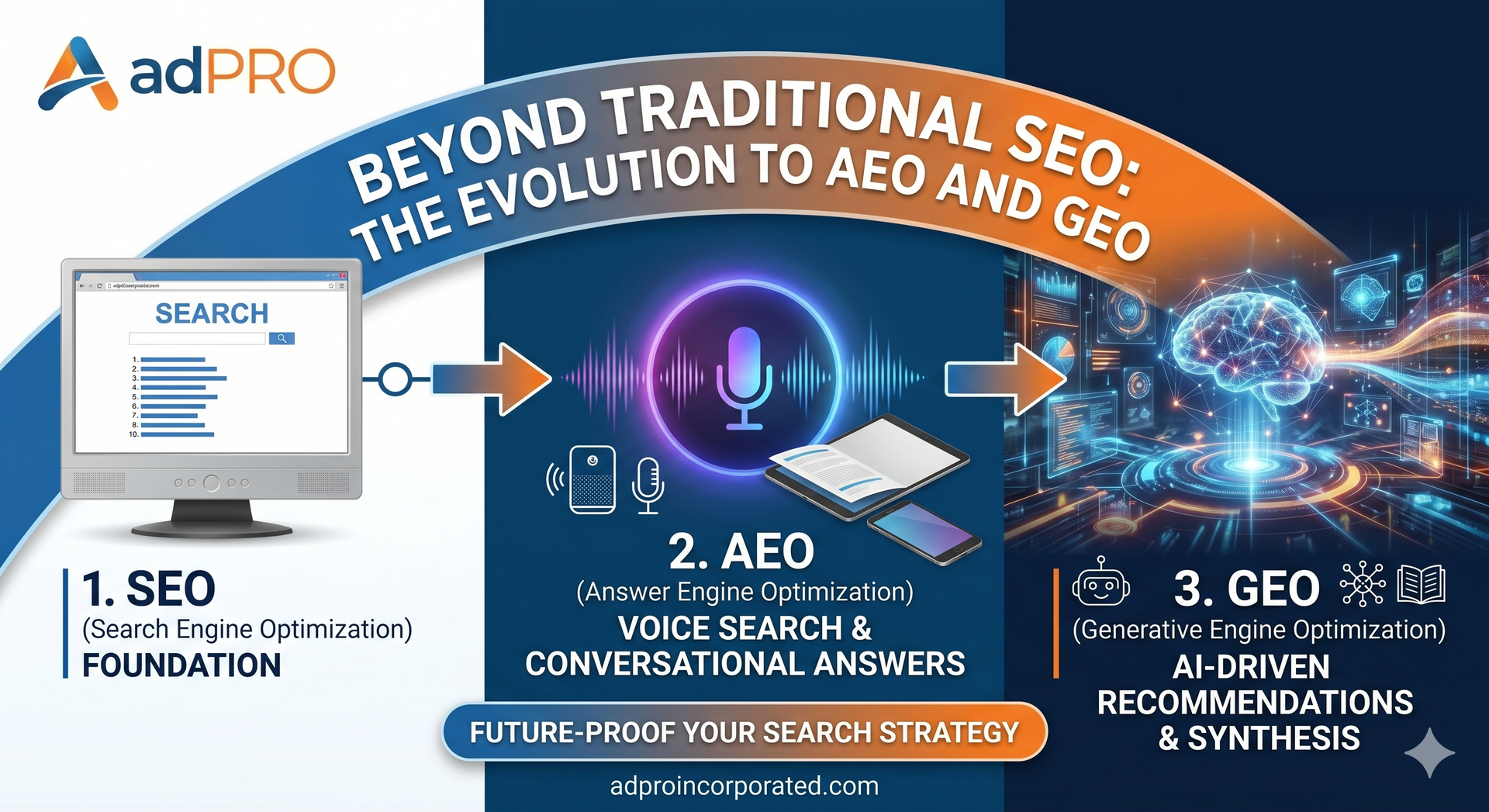
For many small to medium businesses, the biggest hurdle with SEO is the waiting period. Unlike traditional advertising where you buy space and immediately see an impression, SEO is about building a reputation. Google needs to crawl your site, understand your expertise, and see how users interact with your content before it trusts you enough to rank you highly. For a new website, this process can take several months of consistent effort. Even for established businesses, moving from page two to the top three positions on page one requires a strategic commitment to AEO and GEO optimization and high-quality content creation.
At adPRO, we have seen that the most significant SEO breakthroughs often happen after the first 90 days. During this initial window, we focus on fixing technical errors, optimizing website design , and targeting the right keywords. Once the foundation is solid, the "snowball effect" begins. Your rankings improve, leading to more clicks, which signals to Google that your site is valuable, leading to even higher rankings. This compounding interest of traffic is why SEO is often the most cost-effective long-term strategy for local businesses from Calvert County to across the United States.
Core Benefits of Using Google Ads for Quick Wins
While SEO builds the foundation, Google Ads acts as the fuel. There are specific scenarios where waiting months for organic growth isn't an option. If you are launching a new product, running a seasonal sale, or entering a highly competitive market, Google Ads provides the shortcut you need. It allows for incredibly granular targeting. You can specify the time of day your ads appear, the geographic location of the searcher, and even the type of device they are using. This precision ensures that your marketing budget is spent on the highest-intent leads possible.
Benefits of a well-managed Google Ads campaign include:
- Immediate Visibility: Your business appears at the top of search results the day your campaign goes live.
- Targeting Precision: Focus on specific zip codes, demographics, and searcher behaviors.
- Budget Flexibility: You can start with a small daily budget and scale up as you see a positive return.
- Measurable ROI: Every penny is tracked, allowing you to see exactly which keywords lead to phone calls or sales.
- A/B Testing: Quickly test different headlines and offers to see what resonates best with your audience.
Which strategy provides a better ROI for small businesses?
The answer to which strategy is "better" depends entirely on your current business goals and cash flow. For a small business just starting out, Google Ads is often the better choice to generate immediate revenue. If you don't have a steady stream of leads, you cannot wait six months for SEO to kick in. However, relying solely on paid ads can be a dangerous trap. As competition increases, the cost-per-click (CPC) usually rises, which can eat into your profit margins over time. This is why we recommend a balanced approach that transition into a stronger focus on organic growth as the business matures.
In the long run, SEO almost always provides a higher Return on Investment (ROI). Once you rank for a valuable keyword, you stop paying for every individual visitor. A well-optimized page can continue to bring in high-quality leads for years with only minimal maintenance. When you compare the total cost of a year-long SEO campaign against a year of paid ads, the SEO leads usually end up costing a fraction of the price. The key is to survive the "gap"—the time between starting SEO and seeing the leads come in—by using targeted Google Ads to keep the lights on and the phones ringing.
How to Integrate SEO and Google Ads for Maximum Impact
Smart business owners don't choose between SEO and Google Ads; they use them in tandem. This integrated approach is a cornerstone of the philosophy we’ve held at adPRO since 1999. When these two channels work together, they create a "1+1=3" effect. For example, you can use Google Ads data to identify which keywords have the highest conversion rates. Instead of guessing what to write about for SEO, you use the proven data from your paid campaigns to guide your content strategy. This ensures that when you finally do rank organically, you are ranking for terms that actually make you money.
Furthermore, having both a paid ad and an organic listing on the same page increases your brand's authority. Users who see your business twice are more likely to trust you and click on one of your links. This concept, often called "SERP dominance," makes it much harder for your competitors to steal your potential customers. You can also use "Remarketing" in Google Ads to show ads specifically to people who previously visited your site through an organic search but didn't buy anything yet, keeping your business top-of-mind.
Ways to combine the two strategies:
- Keyword Research: Use Ads to find high-performing keywords for your SEO content.
- Brand Protection: Bid on your own business name to ensure competitors don't steal your traffic.
- Content Testing: Test blog post titles as ad headlines to see which gets more clicks before publishing.
- Landing Page Optimization: Use the best-performing ad landing pages as templates for your organic service pages.
- Coverage: Use Ads for keywords where you don't yet rank on page one organically.
Key Takeaways for Your Marketing Strategy
To maximize your growth in 2026, you must view SEO and Google Ads as complementary tools rather than rivals. SEO provides the sustainable, long-term foundation that builds brand equity and lowers lead costs over time. Google Ads offers the agility, speed, and precision needed to capture immediate demand and test new markets. For most small to medium businesses, the ideal strategy involves launching with a heavy emphasis on Google Ads to generate cash flow, while simultaneously investing in a robust SEO and website design plan that will eventually take over as the primary driver of traffic.
Next Steps for Your Business:
- Evaluate your current needs: Do you need leads today (Ads) or a lower cost-per-lead in six months (SEO)?
- Audit your website’s technical health to ensure any SEO effort isn't wasted on a broken foundation.
- Start a small, targeted Google Ads campaign to identify your most profitable keywords.
- Consult with an experienced agency like adPRO to build a strategy based on data, not guesswork.
- Monitor your competitors to see where they are outranking you organically and where they are spending on ads.
Choosing between SEO and Google Ads doesn't have to be a gamble. By understanding the timing, costs, and strengths of each, you can build a diversified digital marketing engine that drives consistent growth for your business. Whether you are serving local clients in Southern Maryland or a national audience, a balanced approach ensures you are visible exactly when and where your customers are looking for you.
It's Your Business, Let's Build it!
We will get back to you as soon as possible.
Please try again later.